CAREER
7 Key Strategies of Requirement Analysis for Success in the Modern Workplace
March 21, 2023 • 5 Min Read
7 Key Strategies of Requirement Analysis for Success in the Modern Workplace
Unlock Your Business Growth Potential with Proven Expert Tips and Best Practices for Conducting Effective Business Requirement Analysis
Business Requirement Analysis is a critical step in the effective completion of any project. It is a thorough procedure for finding, assessing, documenting, and validating business requirements. The primary purpose of this process is to learn what the project’s stakeholders anticipate from it and to guarantee that the end output matches their expectations. The purpose of this article is to give a thorough approach for Business Analysts (BAs) to undertake successful requirement analysis.
Best Practices
Business requirement analysis is a critical procedure for every firm to properly achieve its goals. It is a methodical strategy for identifying, analyzing, and documenting the requirements of a business process or project. The purpose is to offer a clear knowledge of the project’s expectations, scope, and limits. This article will go over some step-by-step business requirement analysis best practices.
A — Project Evaluation

Photo by Glenn Carstens-Peters on Unsplash
BAs must first assess the project’s objectives, scope, and stakeholders before beginning the requirement analysis process. This evaluation will assist BAs in understanding the project’s aims and the demands of the stakeholders. All stakeholders, including end users, sponsors, company owners, and subject matter experts, must be identified by BAs. They must also comprehend the scope of the project, including the intended deliverables, timetable, and budget. The evaluation will assist BAs in tailoring the requirement analysis approach to match the demands of the project.
B — Create a Requirements Repository
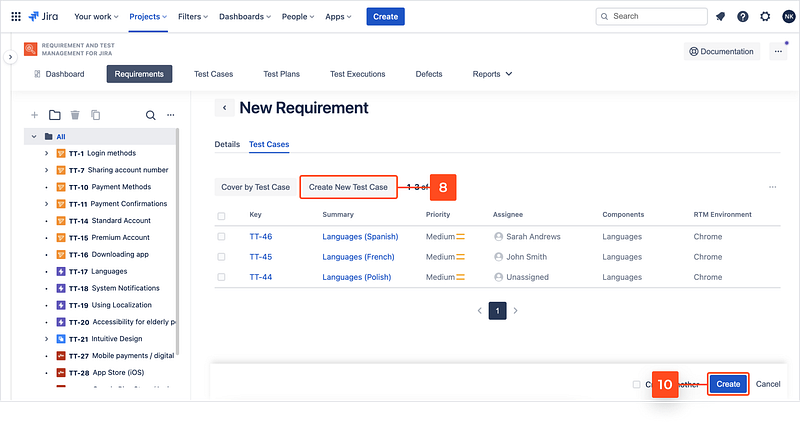
Sample Requirement Repository
A requirements repository is a single area where business analysts store and manage all requirements acquired during the requirement analysis process. A repository is necessary because it aids in the organization, tracking, and management of requirements throughout the project's lifetime. BAs may create a repository using a variety of technologies, including Microsoft Excel, SharePoint, or a Requirements Management System (RMS). The repository should be freely available and routinely updated to ensure that all stakeholders are up to speed on the most recent needs.
C — Holding Required Collecting Meetings

Photo by Rodeo Project Management Software on Unsplash
The requirement analysis method is built on requirement-gathering sessions. In these meetings, stakeholders are engaged to elicit, clarify, and validate requirements. Interviews, seminars, surveys, and focus groups are all examples of requirement-gathering activities that BAs must do. Each session has advantages and disadvantages, and BAs must select the optimal session depending on the availability of stakeholders and the goals of the project. Throughout the sessions, BAs must ask open-ended questions, actively listen to stakeholders, and take notes. They must also guarantee that all stakeholders participate in the sessions and are engaged.
D — Requirements Documentation and Analysis

After gathering requirements, BAs must document and assess them. The documentation should include a description of the demand, its priority, its source, and other pertinent facts. BAs must utilize a uniform template to guarantee that all requirements are consistently written. BAs must assess the requirements once they have been documented to find any conflicts, duplicates, or missing requirements. BAs can assess needs using a variety of methodologies, including requirement prioritization, gap analysis, and feasibility analysis.
E — Ensure Traceability of Requirements
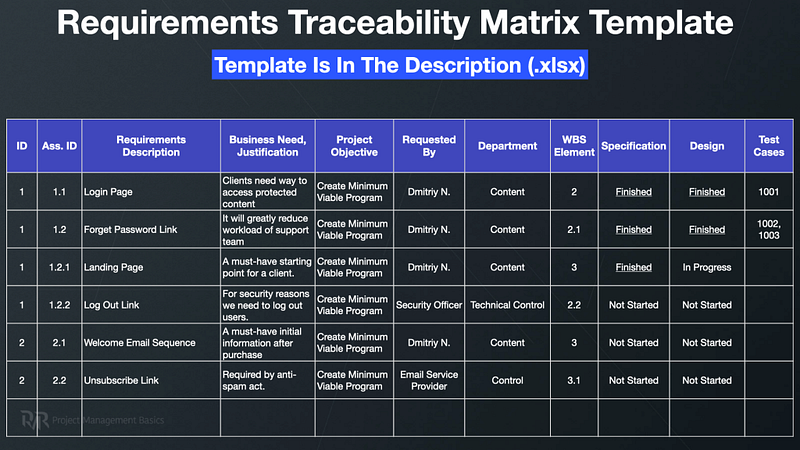
Sample Traceability Matrix
The process of connecting requirements to their sources, dependencies, and test cases is known as requirement traceability. It is critical to guarantee that all requirements can be traced back to their original sources and that any modifications to requirements are monitored and handled. To guarantee requirement traceability, BAs might employ a Requirements Management System (RMS). The RMS should be able to trace requirements from their origins to their final deliverables, as well as track any modifications made to the requirements.
F — Assisting with Requirement Validation

Photo by Daria Nepriakhina 🇺🇦 on Unsplash
The process of verifying that requirements fit the needs and expectations of stakeholders is known as requirement validation. BAs must validate requirements before proceeding with the project to guarantee that the final result fulfills the demands of the stakeholders. BAs can validate requirements using a variety of methodologies including reviews, walkthroughs, and user acceptability testing. To guarantee that stakeholders’ requirements and expectations are satisfied, BAs must include them in the validation process.
G — Obtaining Approval
The final stage in the requirement analysis process is to obtain sign-off. It is the process of formalizing from stakeholders that the criteria fulfill their needs and expectations. Before proceeding with the project, BAs must verify that all stakeholders have reviewed and accepted the requirements.
Finally, adhering to these best practices for business requirement analysis can result in a successful project outcome. It aids in comprehending the project’s objectives, including all stakeholders, gathering and prioritizing needs, verifying and documenting them, and so on. A well-executed requirement analysis process aids in the reduction of project risks, the avoidance of misunderstandings, and the assurance that the final solution satisfies the demands of the stakeholders.
Need guidance? Reach-out to Note-Pad team.