EMAIL MARKETING
Best Time to Send Marketing Emails in 2026: What the Latest Data Actually Says
April 5, 2026 • 12 Min Read
Best Time to Send Marketing Emails in 2026: What the Latest Data Actually Says
Most articles give you 1 magic hour. The real answer is better than that: mid-week, local time, email type, and testing.
If you have ever searched for the best time to send a marketing email, you have probably seen the same advice repeated everywhere: “Send on Tuesday morning.” This advice is not exactly wrong, but it is not complete as well.
The latest data shows there is no single universal send time that works for every brand, every audience, and every email type.
What the data I got is a pattern and very clear:
Mid-week usually performs best, but local time matters, the best time for opens is not always the best time for clicks, and your own list data should always beat generic internet advices.
But people still search for one simple answer for success. But the real answer is better than that.
Because when you’re writing newsletters, campaign emails, lead-nurturing sequences, promotions, or product updates, timing feels like something that should have a clean, universal answer.
Something simple. Something like: “Tuesday at 10 AM.”
But the more I reviewed recent studies and platform insights, the more obvious one thing became: That answer is too simple for how email actually works today.
Yes, there are patterns. Some days do perform better than others. Mid-week mornings still appear again and again in the data.
But no, there is no magical hour that works for every audience, every business, and every email type.
And maybe that is the better news for you.
Because once you stop chasing one mythical “perfect time,” you start focusing on what actually improves email performance: audience behavior, local timing, email intent, segmentation, testing, and deliverability. That is where the real advantage comes from.
The short answer, before we go deeper
If you need a practical starting point, start here:
Best days: Tuesday, Wednesday, and Thursday Best time: around 9 AM to 11 AM in the recipient’s local time Best use case: newsletters, B2B campaigns, educational emails, and general marketing sends
That is the clearest overlap across Mailchimp, Customer.io, Salesforce, and HubSpot’s guidance and research. Mailchimp specifically says the best time for newsletters across its system is 10 AM in recipients’ own time zones, while Salesforce says B2B emails tend to perform best from Tuesday to Thursday, especially around 9 AM to 11 AM. HubSpot’s survey also found Tuesday was the most frequently reported top-engagement day among U.S. marketers.
But here is where it gets more interesting.
That “best time” often works best for opens.
Not always for clicks. And definitely not always for conversions.
That difference matters more than most marketers realize.
The biggest mistake people make with email timing
A lot of articles about email timing still treat open rate like the final truth. But it isn’t.
Open rates can still be useful directionally, but they are no longer strong enough to be your only decision-making metric. Apple’s Mail Privacy Protection limits the ability to accurately determine whether or when an email was opened, and Mailchimp’s MPP guidance says the feature affects the reliability of open data.
So if you are optimizing only for opens, you may be rewarding the wrong behavior.
A campaign that gets opened at 10 AM is not automatically better than a campaign that gets clicked, replied to, or converted later in the day.
And that changes the whole conversation.
Because now the real question is not:
“When do people open emails?”
The better question is:
“When do my people take action?”
That is the question worth optimizing for.
What the latest data keeps pointing to
After reviewing the most recent platform studies and benchmark articles, the broad pattern is still very consistent.
1) Mid-week continues to perform well

Tuesday, Wednesday, and Thursday keep showing up as the strongest default days for email campaigns. Mailchimp says those are the best-established days across industries, Customer.io says Tuesday is the most consistently recommended day but that the real winner is mid-week, and HubSpot’s marketer survey also put Tuesday on top.
Behaviorally, that makes sense too.
Monday is usually crowded and reactive. Friday can be uneven because attention starts shifting. Mid-week tends to feel more stable.
That does not mean Monday or Friday never works. It just means mid-week is still the smartest place to begin.
2) Morning still works well for visibility
For many general campaigns, morning to late morning remains a strong starting point, especially for newsletters and B2B communication. Mailchimp says 10 AM in the recipient’s time zone is the best general send time for newsletters, and Salesforce says B2B engagement tends to be strongest between 9 AM and 11 AM.
That window often catches people when they are clearing inboxes, settling into work, or planning the day.
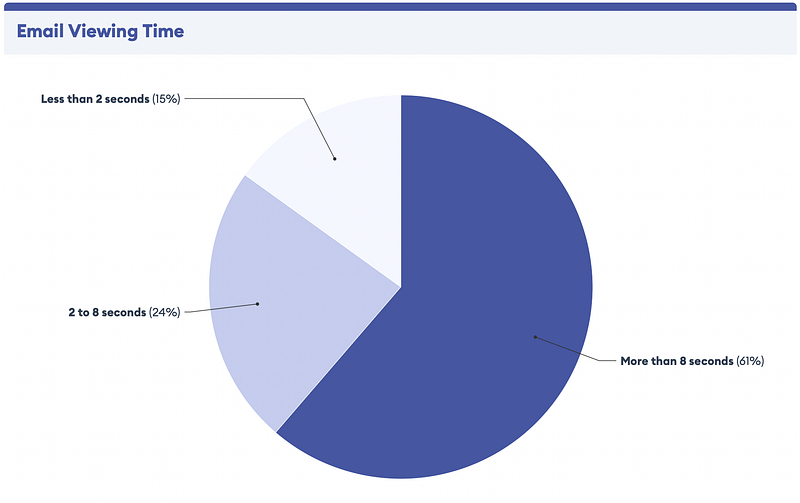
Source: Forbes Advisor
3) Click behavior can look very different
This is where the conversation gets more interesting.
Customer.io notes that the best send time depends on whether you want opens, clicks, or replies, and it highlights 2025 research showing stronger click-through behavior later in the day, including evening peaks. MailerLite’s 2026 analysis also separated open-rate patterns from click-rate patterns, based on 2,138,817 campaigns sent between December 2024 and November 2025.
That makes sense in real life too.
Opening an email during work hours is easy. Actually clicking, reading, exploring, or buying often happens later.
So yes, send time matters. But your goal matters even more.
Opens, clicks, and conversions are not the same game
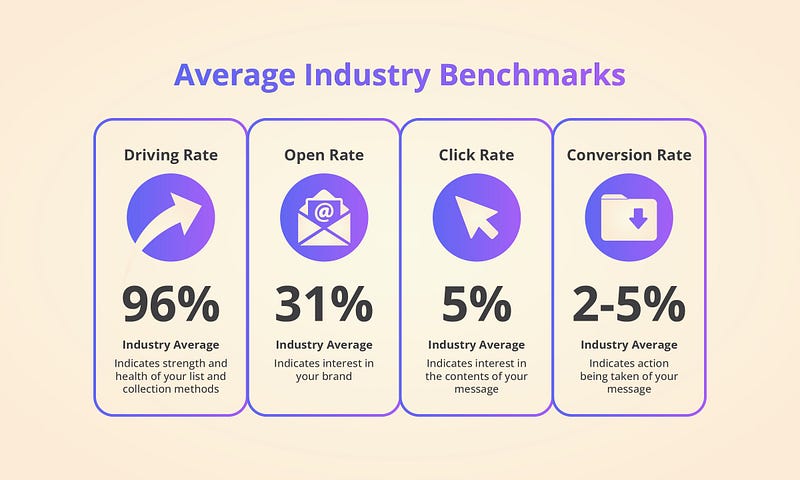
Source: MailMunch
This is where many marketers quietly get misled.
They talk as if engagement is one single thing.
It isn’t.
If your goal is opens, mid-week mornings are still a strong default. If your goal is clicks, later-day testing becomes more important. If your goal is conversions, you need to look beyond generic best-practice advice and pay attention to your own audience behavior, offer type, and buying context.
Because the best time to get an email seen is not always the best time to get it acted on.
And that one shift in thinking can improve your email strategy more than chasing one famous “best hour.”
The best send time also depends on the type of email
This is where generic blog posts often fall apart.
They treat all email campaigns as if they belong to the same category.
They don’t.
A weekly newsletter is not an abandoned cart email. A B2B nurture email is not a flash sale. A product onboarding email is not a webinar reminder.
Different emails live in different moments.
Newsletters and educational content
Start with Tuesday or Thursday morning.
That is still one of the safest patterns if your goal is visibility and consistent readership. Mailchimp explicitly frames Tuesday or Thursday mid-morning as a strong recommendation for a general audience.
B2B lead nurturing and sales emails
Start with Tuesday to Thursday, 9 AM to 11 AM local time.
Salesforce’s B2B guidance points directly in that direction, and HubSpot’s survey also supports a mid-week preference.
Promotional and retail campaigns
Do not lock yourself into “Tuesday morning” just because everyone repeats it.
Mailchimp notes that retail and ecommerce behavior often peaks around late morning or early afternoon, especially Thursdays through Saturdays, and Customer.io’s summary of later click activity is another reason to test beyond office-hour assumptions.
Lifecycle and triggered emails
These should usually follow the user action, not a general campaign calendar.
A welcome email should go when someone signs up. A reminder should align with the event it supports. A cart or behavior-based email should follow the action that triggered it.
That is a different timing model altogether.
Local time matters more than people think
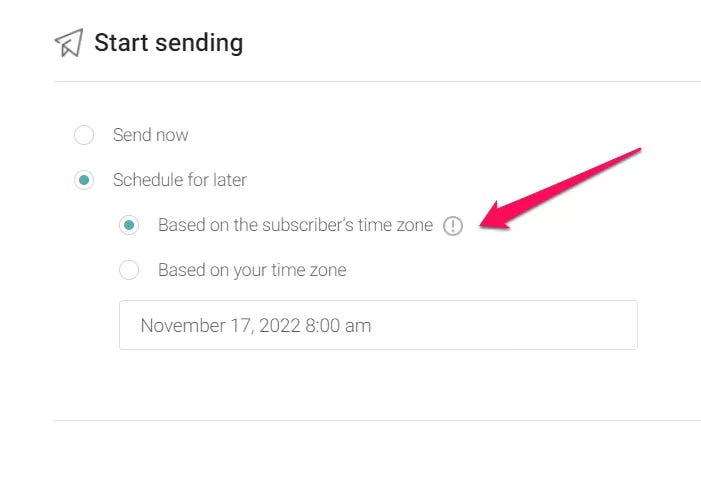
Source: Omnisend
This sounds obvious, but many teams still get it wrong.
They schedule based on their time zone instead of the subscriber’s.
Mailchimp explicitly warns against ignoring audience time zones and says the best general send time is based on the recipient’s own time zone, not yours.
That means a campaign sent at 10 AM from your office might land at 3 AM for someone else.
And then people wonder why the results feel weak.
If your audience is spread across regions, scheduling by the recipient’s local time is one of the easiest wins available.
It is not fancy. It is just smart.
Industry matters too
The inbox behavior of a fintech buyer is not the same as the inbox behavior of an ecommerce shopper.
A nonprofit donor does not behave exactly like a SaaS prospect. A retail customer does not move like a B2B decision-maker.
Salesforce’s guidance separates timing advice by context, and Mailchimp also distinguishes between general audiences, retail and ecommerce, B2B, and nonprofit behavior.
That is why borrowed advice can only take you so far.
Benchmarks are useful. But only as a starting point.
Your audience should always get the final vote.
Timing will not save a weak email
This part matters a lot.
Sometimes marketers obsess over timing because it feels easier than improving the email itself.
But the truth is simple:
Bad timing can hurt a good email. Good timing cannot rescue a weak one.
If the subject line is forgettable, the offer is weak, the message is unclear, or the content is irrelevant, the send time will not perform a miracle.
A strong email still needs relevance, clarity, good targeting, and a real reason to be opened.
Timing helps. But timing is not the hero of the story.
The email is.
Deliverability comes before timing
You can send your campaign at the most data-backed time in the world and still get disappointing results if it lands in spam.
That is why deliverability basics matter first:
- domain authentication
- list hygiene
- low spam complaint rates
- easy unsubscribing
- a list that actually wants your emails
Google’s sender guidelines say bulk senders should use authentication and keep spam rates reported in Postmaster Tools below 0.3%.
So before arguing about whether 10 AM beats 11 AM, make sure your email actually has a healthy chance of reaching the inbox.
A practical way to approach this
If you want a usable framework, here it is.
Start with Tuesday, Wednesday, or Thursday. Send around 9 AM to 11 AM in the recipient’s local time. Use that as your baseline for newsletters, educational content, and B2B campaigns.
Then test beyond that.
Test later-day windows for retail or promotional campaigns. Separate newsletters from lifecycle emails. Measure clicks, replies, conversions, unsubscribes, and revenue, not just opens. And let your own audience data overrule generic internet advice whenever the results are clear.
That is usually where the real progress starts.
My honest conclusion
If someone forced me to give one default answer, I would say this:
Start with Tuesday to Thursday, between 9 AM and 11 AM, in the recipient’s local time zone.
That is still the strongest general starting point across the sources I reviewed. Because, during that time audiences are more settled in and is actively checking messages. Engagement rates surge to 59% during this prime window, significantly outperforming traditional sending times. The 2 PM lunch period offers another substantial opportunity.
Timing your promotional emails around paydays — the first and last days of each month — drives the highest conversion rates at 5.52% (for promotional and retail campaigns).
However, avoid scheduling important campaigns on Mondays or the 23rd of each month, when engagement consistently dips to its lowest levels across all metrics.
But I would also add this immediately:
Do not stop there.
Because the real answer is more human than that.
People do not open, click, and buy in one identical pattern. Different audiences behave differently. Different email types create different moments. Different goals require different timing strategies.
So the smartest email marketers are not the ones who memorize one “best hour.”
They are the ones who test thoughtfully, segment properly, respect the audience’s context, and measure what actually matters.
That is how email gets better.
Not by chasing one magical time slot.
But by learning when your audience is actually ready.
References
This article was informed by benchmark studies, platform guidance, and supporting documentation from the sources below. Email remains a major ROI channel, with Litmus reporting an average return of $36 for every $1 spent, which is part of why send-time optimization still matters.
- MailerLite. The Best Time to Send Email in 2026 (Statistical Analysis). https://www.mailerlite.com/blog/best-time-to-send-email
- Mailchimp. What Is the Best Time to Send a Marketing Email Blast? https://mailchimp.com/resources/insights-from-mailchimps-send-time-optimization-system/
- Customer.io. Best day and time to send marketing emails. https://customer.io/learn/lifecycle-marketing/email-sending-schedule
- Twilio. The Absolute Best Time to Send Email Campaigns in 2025. https://www.twilio.com/en-us/blog/insights/the-best-time-to-send-your-email-campaign
- Forbes Advisor. 49 Top Email Marketing Statistics. https://www.forbes.com/advisor/business/software/email-marketing-statistics-apr-26/
- Klaviyo. The Best Time to Send an Email: 2025 Timing Tips. https://www.klaviyo.com/blog/best-email-send-times
- Salesforce. The Best Time To Send Marketing Emails (2026). https://www.salesforce.com/marketing/email/best-time-to-send-emails/
- HubSpot. The Best Time to Send an Email [2023 Research]. https://blog.hubspot.com/marketing/best-time-to-send-email
- Litmus. Email Marketing ROI. https://www.litmus.com/resources/email-marketing-roi
- Apple Support. Use Mail Privacy Protection on iPhone. https://support.apple.com/guide/iphone/use-mail-privacy-protection-iphf084865c7/ios
- Mailchimp. Apple Mail Privacy Protection (MPP) FAQs. https://mailchimp.com/help/apple-privacy-faq/
- Google Workspace Admin Help. Email sender guidelines. https://support.google.com/a/answer/81126?hl=en