EMAIL MARKETING
The Emails I Actually Read
May 5, 2026 • 16 Min Read
The Emails I Actually Read
A human approach to email marketing, personalization, and campaign writing in the age of AI-polished noise.Personalization is not using someone’s first name. It is making them feel like you noticed what they are carrying.
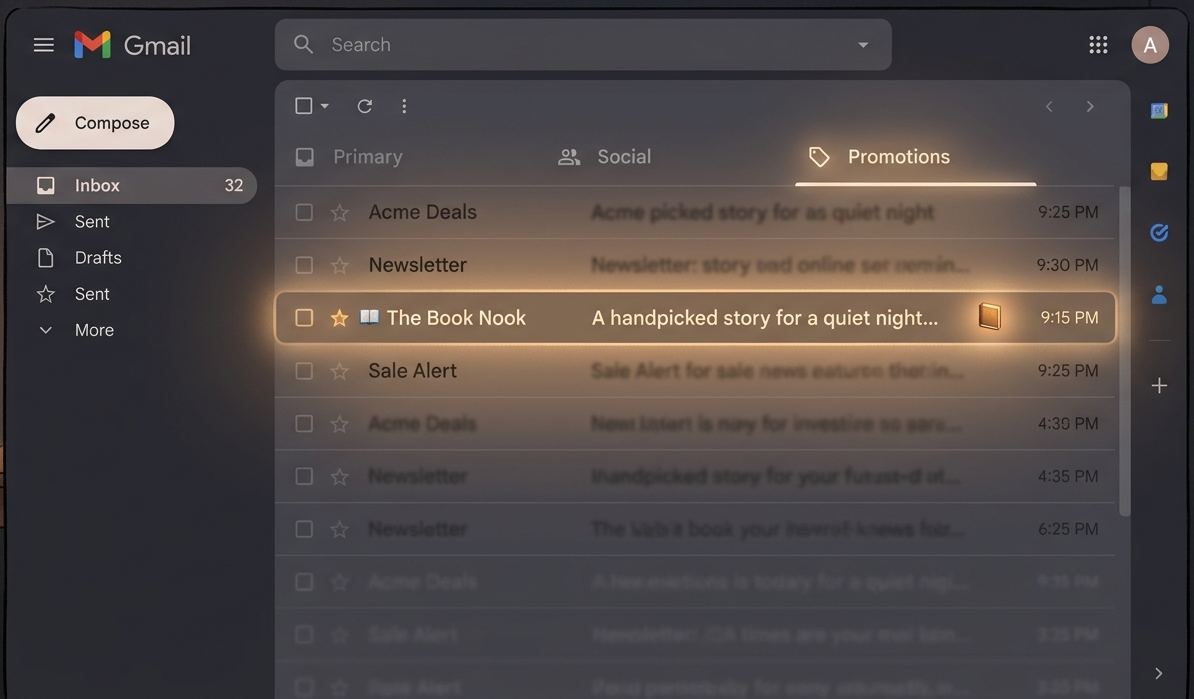
A Gmail Promotions tab with one email standing out from many unread marketing emails, symbolizing human and relevant email marketing.
I found the email by accident.
It was sitting in the Promotions tab of my Gmail.
You know that place, right?
The digital graveyard of discount codes, webinar invites, product launches, “last chance” offers, and newsletters we subscribed to with good intentions but never really read.
I was not there for inspiration. I was looking for an important email. Then I opened one promotional email from a creator.
And I stopped.
Not the polite kind of stop.
The real one.
The kind where your scrolling fingers pause because one sentence feels a little too close to home.
I read it once. Then again. Maybe a third time.
And while reading, I had that strange feeling every good email marketer should be trying to create:
Wait. Is this person talking to me?
Of course, she was not.
I knew that.
It was a campaign. I was on a list. The email was promotional. There was probably a sequence behind it.
But it did not feel like a sequence.
It felt like someone had quietly entered the messy room of my thoughts and pointed at the exact thing I had not yet said out loud.
That is rare.
Two or three days later, I tried to find the same email again.
I could not.
So I did something slightly embarrassing.
I changed my Gmail categorization.
That small moment changed how I think about email marketing techniques, email personalization, and what actually makes people keep reading.
For a promotional email.
Just so I could find her next one.
I felt a little silly doing that.
Who changes Gmail settings for a promotional email?
But maybe that was exactly the point.
The email did not behave like a promotion in my mind. It behaved like something I wanted to return to.
That moment taught me more about email marketing techniques than many frameworks I had read before.
Most marketers are fighting for open rates.
But the best emails make people rearrange their inbox.
Most emails do not sound bad. They sound empty.
This is the strangest thing.
Most marketing emails today are not terrible.
They are clean, structured, grammatically correct, have a subject line, a CTA, and they follow the rules.
And still, you forget them five seconds after reading (if you still read this accidentally).
Why?
Because they sound like they were written for a campaign calendar, NOT FOR A PERSON.
They have polish, but no pulse.
They have structure, but no scar.
They have personalization, but no understanding.
You can almost feel the checklist behind them:
- Subject line? Done.
- First name? Done.
- Pain point? Done.
- CTA? Done.
- Urgency? Done.
Then, booommm… Send the email.
But readers are not checklists.
Readers are tired people with crowded inboxes, unfinished work, quiet frustrations, and a very low tolerance for anything that wastes their attention.
So when another “Hey [First Name], we thought you might be interested…” email arrives, they do what we all do.
They ignore it.
Not because email is dead. But because the email feels dead.
We have confused personalization with decoration
Let me say this clearly:
Using someone’s first name or last name, is not personalization. It is a merge tag.
Mentioning someone’s company is not personalization. It is the research you did.
Adding a job title is also not a personalization. It is the data you have.
But, Real email personalization is deeper than that. Real personalization happens when the reader feels:
This person understands my situation.
- Not just my name, role, company data from a random 3rd party tool.
My hesitation. My timing. My fatigue. My inner conversation. The thing I am worried about but have not fully explained to anyone yet.
That is why the email I found in my Promotions tab worked on me.
It did not feel like it knew my biodata.
It felt like it knew my mood.
There is a huge difference.
A first name gets attention for one second.
But real situation keeps attention for the whole email.
AI made writing easier. It also made average writing louder.
We should be honest about this.
AI is not the villain.
AI can help us write faster. It can clean up messy drafts. It can structure ideas. It can remove friction from the blank page.
I use AI. Many of us do.
But there is a problem.
When everyone can produce clean writing quickly, clean writing is no longer special. Because the internet is filling up with perfectly acceptable sentences.
- Smooth paragraphs.
- Balanced structures.
- Predictable takeaways.
- Neatly packaged advice.
And somehow, so much of it feels forgettable.
Because the missing part is not grammar.
The missing part is lived experience.
The tiny awkward moments, real failures. The sentence you almost deleted because it felt too honest. The opinion that sounds like you, not like a content template. The specific story that could only come from your life.
AI can help you explain what happened.
But only you can explain why it mattered.
That is the part people highlight, remember and makes someone search for your email again after two days.
The email that wins is not always the smartest one
Sometimes the email that wins is the one that sounds least like it is trying to win.
It admits something.
It starts with a small story.
It says, “I got this wrong.”
It says, “This may not be for you.”
It says, “I know I have emailed a lot this week, so I will keep this short.”
It says what the reader is already thinking.
That is why it feels human.
Not because it is casual, or uses lowercase subject lines, or it adds emojis.
Those are surface things.
The deeper thing is this:
The writer is not hiding behind this polished email.
You can feel a person inside the email.
A person who listened, noticed, willing to be specific, and is not only trying to extract a click from you.
And that matters.
Because people do not build trust with campaigns. They build trust with signals.
Small signals.
- An honest admission.
- A useful sentence.
- A real example.
- A respectful CTA.
- A paragraph that makes you feel seen.
That is how attention becomes trust.
The Human Email Loop
After reading those emails, I kept thinking about what made them work.
At first, I thought it was the writing style.
Maybe the subject lines, tone, storytelling or the casual formatting.
But the more I thought about it, the more I realized something else.
The writing worked because something happened before the writing.
The person had listened.
That is the real email campaign strategy most people skip.
I call it: The Human Email Loop
Listen → Notice → Reflect → Story → Teach → Invite → Learn
It seems Simple, but not easy.
1. Listen before you write
Most campaigns start with the wrong question:
“What should we send?”
A better question is:
“What are people already saying?”
Before you write the email, listen.
Read customer replies, comments, complaints, objections, sales conversations, support tickets. Ask people what they are struggling with.
Do not start with a blank page. Start with the reader’s own words.
Because the best email copywriting often does not come from the writer.
It comes from the audience.
The writer’s job is to notice it, shape it, and send it back with clarity.
A weak campaign says:
Improve your email marketing with better personalization.
A human campaign says:
Maybe your emails are not being ignored because people hate email. Maybe they are being ignored because the reader cannot find themselves inside your message.
2. Notice the problem beneath the problem
People do not always say the real issue directly.
- They say:
“I need better subject lines.”
But maybe the real issue is:
“My emails do not create enough trust for people to keep reading.”
- They say:
“I need more leads.”
But maybe the real issue is:
“I do not know how to explain what I do in a way that feels relevant.”
- They say:
“Our campaign did not perform.”
But maybe the real issue is:
“We sent a message we wanted to send, not the message the reader needed to receive.”
3. Reflect the reader’s inner conversation
A good email does not only describe the reader’s external problem. It also reflects their internal conversation. The private thoughts.
Things like:
“I know I need to send this campaign, but I do not want to sound pushy.”
“I want to use AI, but I do not want my writing to sound like everyone else.”
“I know email works, but I am tired of sending things people do not care about.”
“I keep hearing personalization matters, but I do not know how to do it without sounding fake.”
When a reader sees their own inner conversation written clearly, they pause.
That pause is the beginning of attention.
4. Tell the real story, not the polished version
If you want your email to feel human, add the part you are tempted to remove.
The awkward part. The specific part. The small detail. The honest moment.
“I found a promotional email in my Gmail Promotions tab” is better than “I came across a great email campaign.”
“I read it twice, maybe three times” is better than “It was engaging.”
“I changed my Gmail categorization to find the next email” is better than “It made a strong impression.”
Specificity creates belief.
Generic writing asks the reader to trust you.
Specific writing gives them a reason to.
5. Teach one useful thing
A human email is not only emotional.
It should also help.
The reader should leave with one useful idea.
Not ten.
One.
For example:
- Personalization is not a first name. It is situational understanding.
- A campaign is not a series of reminders. It is a sequence of emotional jobs.
- A subject line should sound like a real person had a reason to write.
- If the CTA feels like a sudden turn, the email did not earn the pitch.
- If your email would be useless without the CTA, it is probably just a sales pitch wearing a story.
One useful idea is enough.
If the reader gets one sentence worth remembering, the email has already done more than most.
6. Invite instead of cornering
Yes, emails need CTAs.
But the energy matters.
There is a difference between:
Book a call now before it is too late.
And:
If this is something you are trying to improve, this may help.
There is a difference between:
Last chance to join.
And:
This is the last time I will mention this for now.
There is a difference between pressure and clarity.
Human emails do not avoid selling.
They simply sell with respect.
They make the offer feel like a next step, not a trap.
7. Learn from what comes back
The campaign does not end after sending.
That is where the loop starts again.
Read the replies.
Not only the numbers.
Numbers tell you what happened.
Replies tell you why.
Who responded? What did they mention? Which sentence did they quote back? Where did they disagree? What did they ask? What did they ignore? What made them say, “This is exactly what I needed”?
That is your next campaign.
This is why the best email marketers get better over time.
Not because they collect more templates.
Because they collect more truth.
What makes an email campaign feel human?
A human email campaign does not depend on first-name personalization, clever subject lines, or polished templates alone.
It works because the message reflects the reader’s real situation. It uses specific stories, honest observations, useful ideas, and respectful calls to action.
It does not only ask:
“How do we get this email opened?”
It asks:
“What would make someone want to keep reading?”
That is the difference.
The goal is not only email engagement.
The goal is recognition.
The reader should feel:
“I know this problem.” “I have thought this before.” “This sounds like my situation.” “This person understands what I am carrying.”
That feeling is hard to fake.
And that is exactly why it works.
A human email campaign structure
If I were building an email campaign using this approach, I would not start with the offer.
I would start with the reader’s reality.
Here is a simple five-email campaign framework.
Email 1: The “I noticed something” email
Purpose: Open the emotional door.
Angle:
I noticed something strange. People are not tired of email. They are tired of emails that sound like they were written by a machine pretending to be helpful.
Sample subject lines:
- I noticed something about email
- maybe email is not the problem
- the emails we ignore
- this felt too familiar
Email 2: The “Maybe we got it wrong” email
Purpose: Challenge a common belief.
Angle:
Maybe personalization was never about using someone’s first name. Maybe it was about understanding what the reader is living through when the email arrives.
Sample subject lines:
- maybe we got personalization wrong
- your first name is not enough
- this is not personalization
- a small mistake marketers keep making
Email 3: The “Real story” email
Purpose: Make the idea memorable.
Angle:
I once found a promotional email by accident, read it multiple times, then changed my Gmail settings just so I would not miss the sender’s next email.
Sample subject lines:
- the email I went looking for
- I changed my inbox for this
- the Promotions tab surprised me
- I actually searched for this email
Email 4: The “Framework” email
Purpose: Give practical value.
Angle:
If you want people to keep reading, build the Human Email Loop: listen, notice, reflect, story, teach, invite, learn.
Sample subject lines:
- the human email loop
- before you write the next email
- write this before the CTA
- a campaign is not a reminder sequence
Email 5: The “Invitation” email
Purpose: Make the next step feel natural.
Angle:
If your emails are technically correct but emotionally ignored, maybe the problem is not the writing. Maybe the problem is that the campaign started too late — at the writing stage, not the listening stage.
Sample subject lines:
- before your next campaign
- if your emails feel too polished
- one last thought on this
- keep this before you send
A few email angles worth stealing
Not copying.
Stealing.
There is a difference.
Copying takes the surface.
Stealing understands the principle.
Here are a few email angles that can make promotional emails feel more human.
1. The honest admission
I used to think better email marketing meant better subject lines. Now I think it means better listening.
Why it works: Because it shows movement. The writer learned something.
2. The anti-marketing angle
You probably do not need another email template. You probably need better language from your actual readers.
Why it works: Because it says what skeptical readers are already thinking.
3. The hidden frustration
Maybe people are not ignoring your emails because they are busy. Maybe they are ignoring them because your message does not feel connected to anything they care about today.
Why it works: Because it goes beyond the obvious problem.
4. The tiny personal story
I once changed my Gmail settings because of a promotional email. That sounds ridiculous. But it taught me something about relevance.
Why it works: Because it is specific, slightly embarrassing, and memorable.
5. The useful distinction
First-name personalization gets attention for a second. Situation-based personalization earns attention for the whole email.
Why it works: Because it gives the reader language they can reuse.
6. The respectful follow-up
I know I have written about this a few times, so I will keep this short.
Why it works: Because it acknowledges reality instead of pretending the reader did not notice.
What human email does not mean
Human email does not mean writing carelessly. It does not mean making everything casual. It also does not mean adding emojis to sound friendly and pretending to be someone’s friend while secretly running a hard-sell campaign.
Readers can smell fake honesty.
Human email means there is evidence of listening inside the message. It means the writer did not simply ask:
“How do I make people click?”
They asked:
“What is my reader already carrying?”
That one question changes the whole email.
Before you send your next campaign
Stop for a minute.
Look at the email.
Not as a marketer.
As a reader.
Ask yourself:
- Does this sound like a person?
- Does it say anything specific?
- Does it contain a real observation?
- Does the CTA feel earned?
- Would I read this if it arrived in my own Promotions tab?
And the hardest question:
- Would anyone search for this email again?
If the answer is no, do not just polish the subject line.
Go back.
Add the missing human signal.
Add the real story. Add the sharper observation. Add the sentence you almost removed. Add the reader’s actual language. Add the uncomfortable truth.
Because people are not waiting for more polished noise.
They are waiting for something that feels written by someone who noticed.
The emails people remember
Most emails ask for attention. The rare ones earn it.
They do not earn it by shouting louder. They earn it by understanding better.
They make the reader feel:
- “I was thinking this.”
- “I needed this language.”
- “This is exactly where I am.”
- “This person is not just sending. They are listening.”
That is why I read those emails.
That is why I searched for them again.
That is why I changed my inbox.
Not because the campaign was perfect.
Because for a few minutes, a promotional email did something most promotional emails fail to do.
It felt human.
And maybe that is the real future of email marketing.
Not more automation. Not more personalization tokens. Not more perfectly polished campaigns.
The future will belong to people who listen deeply enough to write something worth reading.
Frequently Asked Questions
- What is human email marketing? Human email marketing is an approach where emails are written from real audience insight, lived experience, and reader context instead of generic templates or surface-level personalization.
- What is real email personalization? Real personalization is not only using someone’s first name. It is understanding the reader’s situation, hesitation, timing, and inner conversation.
- How can AI help with email writing without making emails sound robotic? Use AI to organize, edit, and clarify your ideas. But bring the raw material yourself: real stories, customer language, mistakes, opinions, and observations.
- What is the Human Email Loop? The Human Email Loop is a simple email campaign framework: Listen, Notice, Reflect, Story, Teach, Invite, and Learn.
More to read
I have written about email marketing strategy, timing, and fundamentals before. This piece is about something deeper: why people keep reading.
You may also like: