CAREER
Tips to answer some tricky interview Questions
June 12, 2019 • 5 Min Read
Tips to answer some tricky interview Questions

When you are facing the interview panel and it is normal that you can feel the adrenaline rush. One of the panellists may ask you a very simple question, like “Tell me something about yourself”. How will you start answering that has it all? Before you start answering, please keep in mind that interviewers nowadays care less about grades and academic executionsand more about your softer skills: how rapidly and creatively a contenderthinks, whether he or she will be able to cope up with high-pressure atmospheres, and how well the candidate will fitin the organization.

Prepare yourself for the big day by getting familiar with the company’s culture and value. It is easy-going to source these type of info from the company annual or media reports, or by connecting with current employees over LinkedIn and looking up reviews on websites like Glassdoor. You’ll have to look for clues: For example, if there is variety in age and overall attrition has been low, it suggests that the company supports its employees, who in turn are possibly respectful of the culture.
Now comes the most critical part: Getting prepared for the complex interview questions. Based on my connections with different recruiters, I came to know that some questions are designed to frighten the candidate in order to check their answers in a stressful condition. Here are some tricky questions you can assume, along with the ideas for abstracting replies that will validate your suitability for the job.
Tell us/me about yourself
This one is one of the scary, open-ended interview question.There are a million answers, and most of them are wrong.
**But, Don’t panic.**There’s a reason employers make you introduce yourself. And — There’s a solid formula to give the perfect answer.
Now, how to Answer the Tell Me About Yourself Interview Question?
-
Start with an important strength the hiring manager is drooling for.
-
Tell how that skill or quality helped your recent employer.
-
Give metrics to show it helped a past employer too.
-
Tell how this new opportunity will help you grow your talents even more.
-
Your best achievement from a recent role.
-
Your best feat from a past job.
Example:
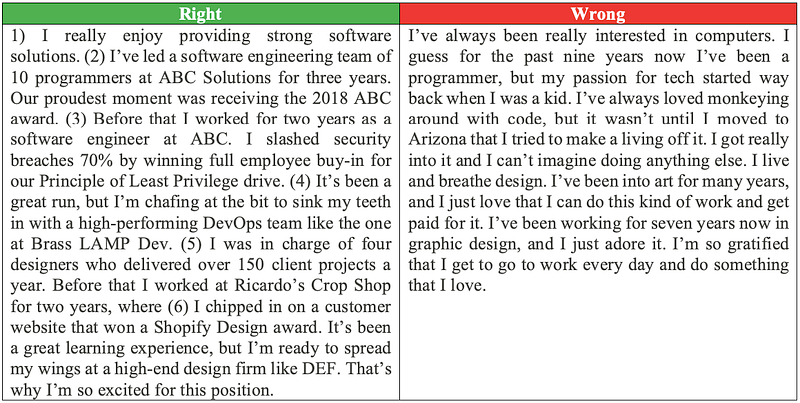
Why should we hire you?
Your answer to this question can be directed to indicate “a fit”. Prove confidence and present your capability to match personality traits with company culture. A response like, “My successes match with your necessities” is a starter to lead the recruiters in a way that’s contented for you.
Sure enough, the very next question will be something like, “What are your achievements and how do you think that those matches with our necessities/requirements?” Now it is the time to discuss about what you have accomplished in life — it can be sports, academics, and extracurricular. Be cautious, though, to link this to learning that is relevant to the position you’re discussing. For example, link your accomplishments in sports to leadership; in academics to project management; your extracurricular activities to team work. The objective is to lead recruiters in a way in which you are comfy without boasting of activities and successes.
What are some of your weaknesses?
This is an exciting question designed to test your honesty.
Spell out a couple of weaknesses as truly as likely. You are human after all! The weaknesses, however, should not seem negative to the work practices. For example, replies such as, “I nit-pick”, “I am in the habit of disturbing”, “I sometimes tend to talk while eating” are impartial and perhaps won’t hurt your probabilities to get the job. Be careful not to open up too much or uncover too many of your weaknesses. Be different and unique in your statements. Do not copy or follow your seniors or others. Remember, you don’t have to list more than two weaknesses.
What is more vital to you — targets or policies?
A question that speak to the long-lasting debate on whether the end certifies the means.
For decades, philosophers have claimed the dominance of one over the other and, to the best of my knowledge, have still not found an answer. Expecting you to give a conclusive response to this question is a kind of test to check how well you think on your feet. Consider these sorts of answers: “I’ve learned to score goals while playing by the rules”; “Are there goals that can be scored when one doesn’t play by the rules?”; or “Would you consider a goal scored if we don’t play by the rules?”
Do you have any question or anything to know?
This is generally the last question in the interview.
Your response to this question should be structured after you have carefully assessed parameters critical for the company. This assessment can be part of your interview preparation stage. Is the company in its growth phase or mature? Structure your answers accordingly. For example, “What are the targets you want me to reach in the first phase?”
Remember that from the second you walk through that door to end, someone is critically seeing you and developing an impression. Its’s not only just what you say, but also what you do not say — that is, your non-verbal cues. The first imprint created by a candidate is normally what helps them navigate easily through the interview process. Walk in confidently, maintain eye contact, and begin with a nice, firm handshake and take the interview questions by storm!