CAREER
Worldwide Hibernation due to COVID-19: Poverty up, Economy down
March 17, 2021 • 13 Min Read
Worldwide Hibernation due to COVID-19: Poverty up, Economy down
The pandemic has been an enormous synchronised global economic shock on a scale which has not been seen since the second world war.
Source: Collected
The COVID-19 pandemic is spreading worldwide again with alarming speed. Infecting millions of people and bringing the economic activity to a near-standstill again, as most of the countries are imposing tight restrictions on movement to halt the spread of the new form of the virus. As the health and human toll is growing, the economic damage is already evident and represents the largest economic shock the world has experienced in decades. After the first and second waves, people are trying to re-establish their economic condition, and then when they are just ready, this covid-19 hitting again.
Covid-19 has brought the global economy to its knees. The pandemic has been an enormous synchronised global economic shock on a scale which has not been seen since the second world war. By the end of 2020 the world’s GDP was about 7.5% lower than it would have been without the pandemic. Globally more than 20% of young people who were in work before covid-19 have lost their jobs. Widespread lockdowns have turbocharged changes that were already affecting the world economy in technology, finance and trade.
Since mid-March 2020, most of the people are losing the job and had no work to do and no money to feed their family. Doctors who are serving for a long time has never dreamed in their medical career, that hospitals will run out of oxygen in such a global pandemic. Yet some hospitals are now in that critical situation, as doctors say that the third wave of the coronavirus pandemic is pushing the country’s National Health Service to its limits.
As per a senior doctor of a leading hospital,
“We’re seeing younger patients now, we’re seeing more sicker patients, and we’ve never really recovered from the first and second wave of covid-19”
You can’t sugarcoat the situation. It is unimaginably bad.”
A recent study conducted by a group of local NGOs in Bangladesh concluded that every three out of five people in the country are at high risk of facing economic and health vulnerabilities. Those people who are losing their jobs are from the bottom of the pyramid.
The June 2020 Global Economic Prospects describes both the immediate and near-term outlook for the impact of the pandemic and the long-term damage it has dealt with the prospects for growth. The baseline forecast envisions a 5.2 percent contraction in global GDP in 2020, using market exchange rate weights — the deepest global recession in decades, despite the extraordinary efforts of governments to counter the downturn with fiscal and monetary policy support. Over the longer horizon, the deep recessions triggered by the pandemic are expected to leave lasting scars through lower investment, an erosion of human capital through lost work and schooling, and fragmentation of global trade and supply linkages.
The U.K. is currently enduring a painful third wave of COVID-19, far worse than its European neighbors like Spain, France, Italy, and Germany. (The Republic of Ireland currently has the world’s highest number of confirmed new COVID-19 cases per capita). This new variant estimated to be up to 70% more transmissible.
The new variant of COVID-19 first reported in mid-December is partly to blame for the grave situation in England, experts say. Mutations in the virus make this new strain 50%-70% more transmissible than others, scientists estimate.
Covid-19 rates in Europe

The crisis highlights the need for urgent action to cushion the pandemic’s health and economic consequences, protect vulnerable populations, and set the stage for a lasting recovery. For emerging markets and developing countries, many of which face daunting vulnerabilities, it is critical to strengthen public health systems, address the challenges posed by informality, and implement reforms that will support strong and sustainable growth once the health crisis abates.
More people are becoming poor
According to the study, among the 100.22 million people at high risk of economic and health vulnerabilities, 53.64 million are extremely poor. These people earn less than €1.7/$1.9 a day. In another recent study, it came out that more than half of these extremely poor people are running out of money. Due to a severe constriction of economic activity as a result of the COVID-19 pandemic, more and more people are going down the extreme poverty-lane.
According to the South Asian Network on Economic Modeling (SANEM), Bangladesh’s poverty rate may double to 40.9% from that prior to the onset of the pandemic. The poor and vulnerable people are becoming more vulnerable. So the inequality in society will increase. People from the informal sector, which account for almost 80–90% of the jobs in Bangladesh. The pandemic has hurt them the most. Between the first and second waves, the average family income subsided by as much as 74%. If these people come out of their homes out of hunger, there is no scope for physical distancing and hygiene maintenance.
Historic contraction of per capita income
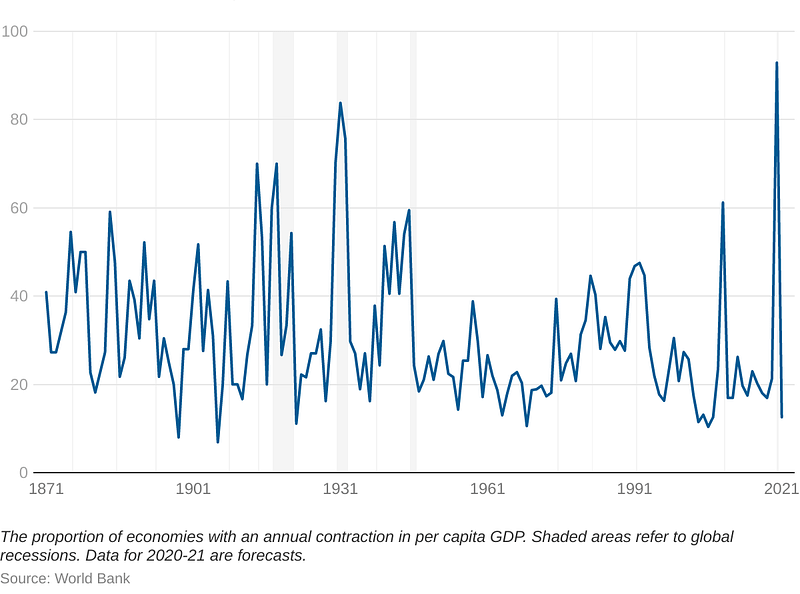
The pandemic experienced most countries into recession in 2020, with per capita income contracting in the largest fraction of countries globally since 1870. Advanced economies are projected to shrink 7–8 percent. That weakness will spill over to the outlook for emerging markets and developing economies, who are forecast to contract by 2.5 percent as they cope with their own domestic outbreaks of the virus. This would represent the weakest showing by this group of economies in at least sixty years.
“The crisis highlights the need for urgent action to cushion the pandemic’s health and economic consequences, protect vulnerable populations, and set the stage for a lasting recovery.”
Every region is subject to substantial growth downgrades. East Asia and the Pacific will grow by a scant 0.5%. South Asia will contract by 2.7%, Sub-Saharan Africa by 2.8%, Middle East and North Africa by 4.2%, Europe and Central Asia by 4.7%, and Latin America by 7.2%. These downturns are expected to reverse years of progress toward development goals and tip tens of millions of people back into extreme poverty.
Emerging market and developing economies will be buffeted by economic headwinds from multiple quarters: pressure on weak health care systems, loss of trade and tourism, dwindling remittances, subdued capital flows, and tight financial conditions amid mounting debt. Exporters of energy or industrial commodities will be particularly hard hit. The pandemic and efforts to contain it have triggered an unprecedented collapse in oil demand and a crash in oil prices. Demand for metals and transport-related commodities such as rubber and platinum used for vehicle parts has also tumbled. While agriculture markets are well supplied globally, trade restrictions and supply chain disruptions could yet raise food security issues in some places.
A steep downturn
The worldwide manufacturing sector has also suffered a huge blow, especially the ready-made garments sector, which accounts for around 80% of Bangladesh’s total export earnings. At least 4 million workers depend on the textile industry for their livelihood.
After the pandemic hit Europe and the US, the industry experienced a reduction in exports of as much as 84% in April 2020 compared with that of the previous year. More than 1,000 factories have been closed and 2.19 million workers lost their jobs.
According to the Export Promotion Bureau of Bangladesh (EPB), in March 2020, the export earnings were just €460.5 million/$520 million, down from €2.68 billion/$3.03 billion in the same month of last year.
A possibility of even worse outcomes

Even this bleak outlook is subject to great uncertainty and significant downside risks. The forecast assumes that the pandemic recedes in such a way that domestic mitigation measures can be lifted by mid-year in advanced economies and later in developing countries, that adverse global spillovers ease during the second half of 2020, and that widespread financial crises are avoided. This scenario would envision global growth reviving, albeit modestly, to 4.2% in 2021.
However, this view may be optimistic. Should COVID-19 outbreaks persist, should restrictions on movement be extended or reintroduced, or should disruptions to economic activity be prolonged, the recession could be deeper. Businesses might find it hard to service debt, heightened risk aversion could lead to climbing borrowing costs, and bankruptcies and defaults could result in financial crises in many countries. Under this downside scenario, global growth could shrink by almost 8% in 2020.
Looking at the speed with which the crisis has overtaken the global economy may provide a clue to how deep the recession will be. The sharp pace of global growth forecast downgrades points to the possibility of yet further downward revisions and the need for additional action by policymakers in coming months to support economic activity.
A particularly concerning aspect of the outlook is the humanitarian and economic toll the global recession will take on economies with extensive informal sectors that make up an estimated one-third of the GDP and about 70% of total employment in emerging markets and developing economies. Policymakers must consider innovative measures to deliver income support to these workers and credit support to these businesses.
Long-term damage to potential output, productivity growth
Now we have the pandemic an economic downturn that’s very deep and I think it’s important that governments don’t repeat the mistakes like last year. So far, spending is exactly what governments have been doing, and to pay for that spending governments have been borrowing a lot.
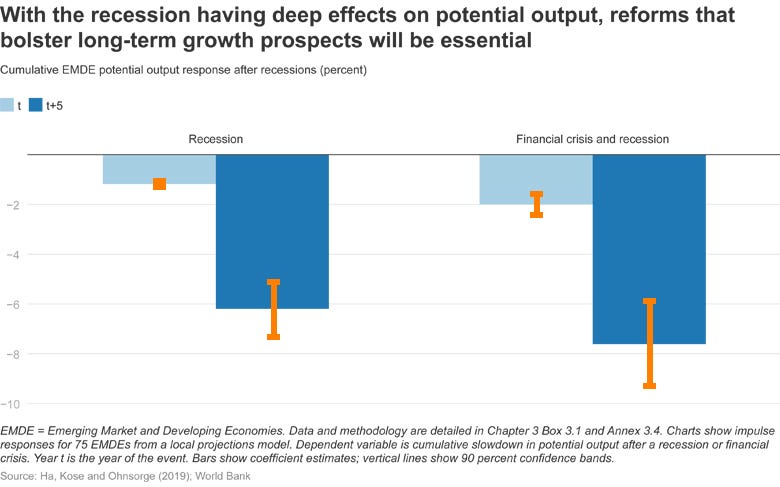
The June 2020 Global Economic Prospects looks beyond the near-term outlook to what may be lingering repercussions of the deep global recession: setbacks to potential output — the level of output an economy can achieve at full capacity and full employment — and labor productivity. Efforts to contain COVID-19 in emerging and developing economies, including low-income economies with limited health care capacity, could precipitate deeper and longer recessions — exacerbating a multi-decade trend of slowing potential growth and productivity growth. Many emerging and developing economies were already experiencing weaker growth before this crisis; the shock of COVID-19 now makes the challenges these economies face even harder.
Another important feature of the current landscape is the historic collapse in oil demand and oil prices. Low oil prices are likely to provide, at best, temporary initial support to growth once restrictions to economic activity are lifted. However, even after demand recovers, adverse impacts on energy exporters may outweigh any benefits to activity in energy importers. Low oil prices offer an opportunity to oil producers to diversify their economies. In addition, the recent oil price plunge may provide further momentum to undertake energy subsidy reforms and deepen them once the immediate health crisis subsides.
In the face of this disquieting outlook, the immediate priority for policymakers is to address the health crisis and contain the short-term economic damage. Over the longer term, authorities need to undertake comprehensive reform programs to improve the fundamental drivers of economic growth once the crisis lifts.
Policies to rebuild both in the short and long-term entail strengthening health services and putting in place targeted stimulus measures to help reignite growth, including support for the private sector and getting money directly to people. During the mitigation period, countries should focus on sustaining economic activity with support for households, firms, and essential services.
Global coordination and cooperation — of the measures needed to slow the spread of the pandemic, and of the economic actions needed to alleviate the economic damage, including international support — provide the greatest chance of achieving public health goals and enabling a robust global recovery.
How long lockdown should last?
There’s no clear end in sight for lockdown worldwide. Although many governments tentatively marked the date of mid-March to begin easing measures, it’s not working again. Transmission is so high that, according to estimates, 1 in 50 people currently have COVID-19.
It’s unclear if it will be possible to roll out the vaccine that quickly, though. Since vaccines began to be administered on Dec. 8, only 2.4 million people have received the first dose. The U.K. has so far approved three COVID-19 vaccines: those produced by Pfizer-BioNTech, AstraZeneca-Oxford, and most recently Moderna.
In the meantime, the outlook for hospitals worldwide looks bleak. According to a UK-based report, the NHS expects London’s hospitals to be short of some 2,000 beds by Jan. 19, even under a “best-case scenario” of lowering transmission rates and emergency hospital facilities being opened.
Social safety-net for the post-covid world

The social safety-net in many rich countries was creaking before covid-19 struck. Modeled on the ideas of Otto von Bismarck and William Beveridge, it had often failed to cushion workers from globalization and technological and social change. In 1999–2019 the number of Americans aged 25–54 outside the labor force grew by 25%, or 4.7m, over six times more than the number who received help from the main assistance program for displaced workers. As health-care and pension costs soared in recent years, governments cut back support for working-age people. Between 2014 and 2018 Britain’s state-pension bill grew in real terms by £4bn ($5.8bn), even as the rest of its welfare budget shrank by £16.5bn. A dwindling share of middle-income jobs and the growth of the gig economy fuelled fears that labor markets were changing faster than flat-footed governments could.
The first step towards satisfying these goals is to use technology to make ancient bureaucracies more efficient. Postal cheques, 1980s mainframe computers, and shoddy data need to be relegated to the past. In the pandemic, many governments temporarily short-circuited their existing systems because they were too slow. In Estonia and Singapore, digital-identification systems and a disdain for form-filling became an asset in the crisis. More countries need to copy them and also to ensure universal access to the internet and bank accounts. The call for efficient administration may sound like tinkering but one in five poor Americans eligible for wage top-ups fails to claim them. Nimbler digital-payment systems will reduce the need for costly universalism as a fail-safe, and allow better targeting and quicker response times. Digital systems also permit the emergency option of making temporary cash payments to all households.
There is one country that combines labor-market flexibility with generosity: Denmark, which spends large sums — 1.9% of GDP in 2018 — on retraining and on advising the jobless. These interventions stop the unemployed from falling into dependency. The inadequacies of policies elsewhere are often glaring. Britain’s efforts have flopped. America’s comparable spending is less than a 20th as large as Denmark’s, even though the few lucky beneficiaries of its “trade-adjustment assistance” earn $50,000 more in wages, on average, over a decade.
Bungee economics
For years social spending has favored the elderly and an outdated safety-net. It should be rebuilt around active labor-market policies that use technology to help everyone from shop workers who are victims of disruption to mothers whose skills have atrophied and those whose jobs are replaced by machines. Governments cannot eliminate risk, but they can help ensure that if calamity strikes, people bounce back.
Also Read: What worldwide hibernation days warns us?
Write me back with your feedbacks to golamasad.pias@yahoo.com